About Art x Andre

A reflection on the artist, the practice, and the ideas that connect them.

Bio

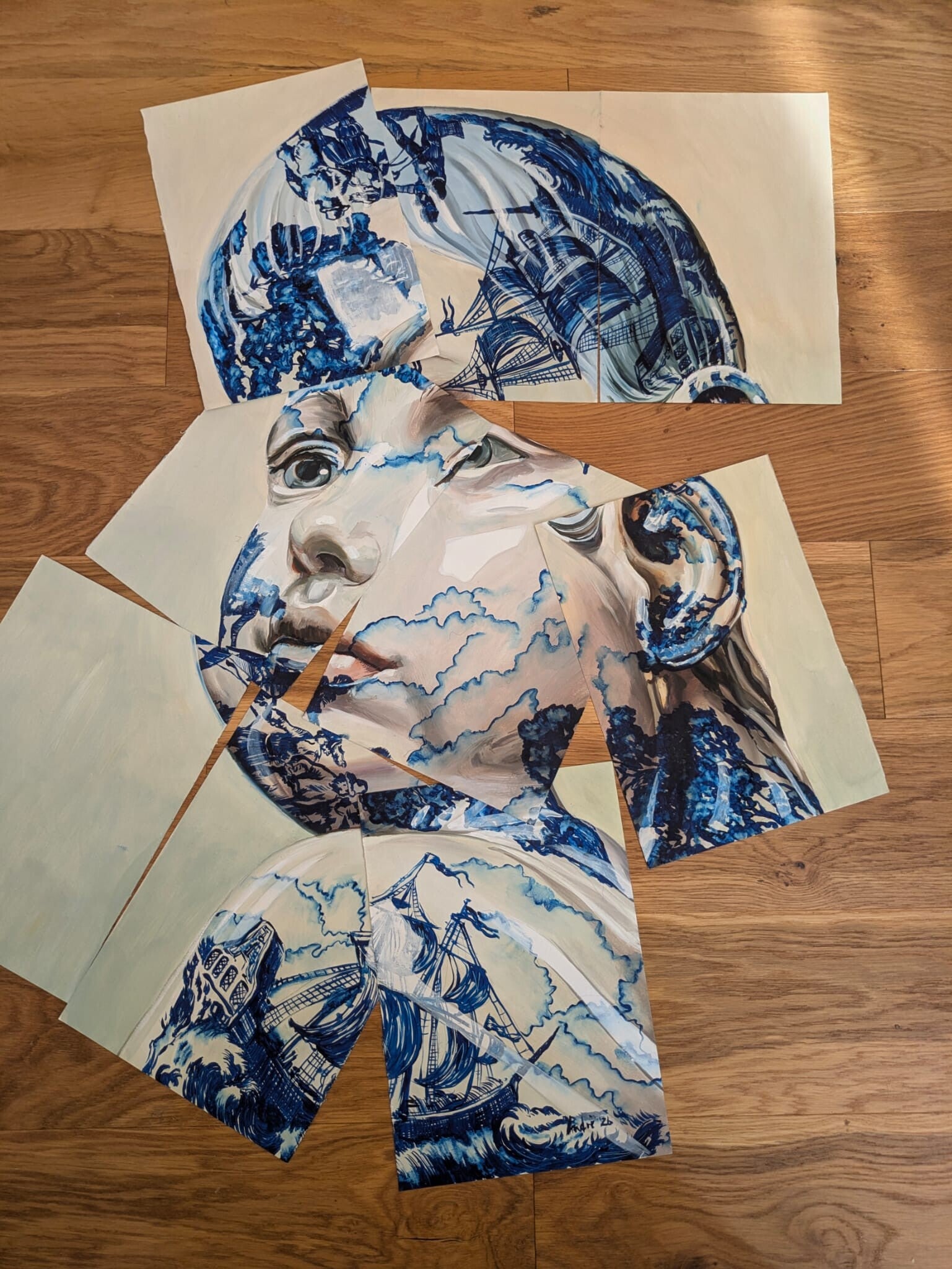
Born in South Africa and working between Cape Town and Turin, Italy, André Jacobs creates fragmented works on paper. What first emerged as a personal process because of time constraints gradually developed into a practice centred on fragmentation, belonging, and the continual negotiation between inherited histories and lived experience.

His practice began as a personal attempt to understand the distance between where he came from and who he was becoming, discovering that distance itself can become a way of looking more closely at home.

Artist Statement

My work explores how identity is assembled rather than inherited. Working across fragmented drawings constructed from multiple sheets of paper, I use absence, interruption and reconstruction as both process and metaphor.

Across the series Time, Ghost Stories and Porcelain Baby, recurring themes of memory, visibility, cultural inheritance and belonging unfold through different visual languages. Rather than presenting fixed narratives, the works remain intentionally incomplete, inviting viewers to assemble meaning for themselves.

Necessity to Solution

What started as a practical solution to time constraints gradually became part of the work itself. Building each piece from individual sheets not only gives me the freedom to work at a larger scale, but also makes the work easier to package, transport and live with. Large works no longer need to be treated as immovable objects, making them more accessible for both artist and collector.

The process doesn't end when the work leaves my studio. Each piece is assembled by the collector, becoming part of the artwork itself. I like thatit shifts the work from something precious and untouchable into something that is handled, lived with and completed in its final home. In a small way, you, the collector becomes part of the same process that first brought the work into being.

BIO (Why i'm doing it)

Coming from a small, conservative, religious, and racially divided community, my first instinct growing up was to escape—escape boredom, escape limitation, escape the simplicity of existence.
Yet once I found that “freedom,” distance reshaped my understanding. What I had once perceived as a cage began to feel, in retrospect, like a form of freedom. I found myself reaching back toward it—not necessarily to return, but to understand it, or perhaps to reconstruct an idea of it.
After moving to Italy, I became increasingly aware that my thoughts were anchored in my relationship to South Africa. With the perspective that distance provides, I began, hesitantly, to investigate my past—what my life was, what it meant, and how it continues to shape where I am and where I might go. This process was uncomfortable and confrontational, prompting a reaction. The only language I had to navigate it was art.
This forms the basis of my practice: an attempt to contextualize myself within a place I undeniably belong to, yet which no longer belongs to me in the ways I once believed.
Art was not a quality widely valued in the community I came from, and this created an internal conflict. To protect that part of myself, I chose to hide it. What I did not anticipate was that while the ability remained, critical thought became buried even deeper.
My practice now seeks to dismantle those internal barriers—to uncover, release, and give form to thought. Although still in its infancy, I feel I have begun to identify the essential elements needed to express something far greater than the sum of its parts.


Process & Practice

(A Unique Approach to Storytelling)

My work is primarily defined by a puzzle-like collage technique. What began as a practical solution—working within the constraints of fatherhood, a full-time job, and limited resources—evolved into a central language within my practice. In the Time series, each fragment was painted individually and only later assembled, forming a layered and often unexpected interpretation of the source material.

Over time, I came to understand this method as a metaphor for life itself: we construct meaning through fragments—moments, memories, and phases—only fully perceiving their coherence in retrospect. The work, therefore, is not driven by the pursuit of immediate beauty, but by a commitment to making each individual part resolved, trusting that the whole—once revealed—will carry its own quiet integrity.

This approach has since expanded into the Porcelain Baby, Ghost Stories, and Flora series. Working with paper in particular has allowed for greater flexibility, where arrangement and reconfiguration become integral to the process. It opens space for both control and accident, where meaning can emerge unexpectedly—often shaped as much by circumstance as by intention

From "Necessity" to creative solutions 

This process is not only a continuous source of creative possibility, but also introduces a practical sensitivity to how the work moves through the world. By existing in parts, the artworks can be shipped and packaged with greater ease, reducing the burden and cost often associated with transporting large-scale pieces—for both artist and collector.

It also opens the potential for expansive works that are assembled by the collector themselves. In doing so, the boundary between artwork and audience shifts. The act of installation becomes a moment of engagement, breaking down the distance that often renders contemporary art precious and inaccessible.

Through this interaction, the work gains a more intimate presence—no longer fixed and untouchable, but lived with, handled, and completed in collaboration with its final space.